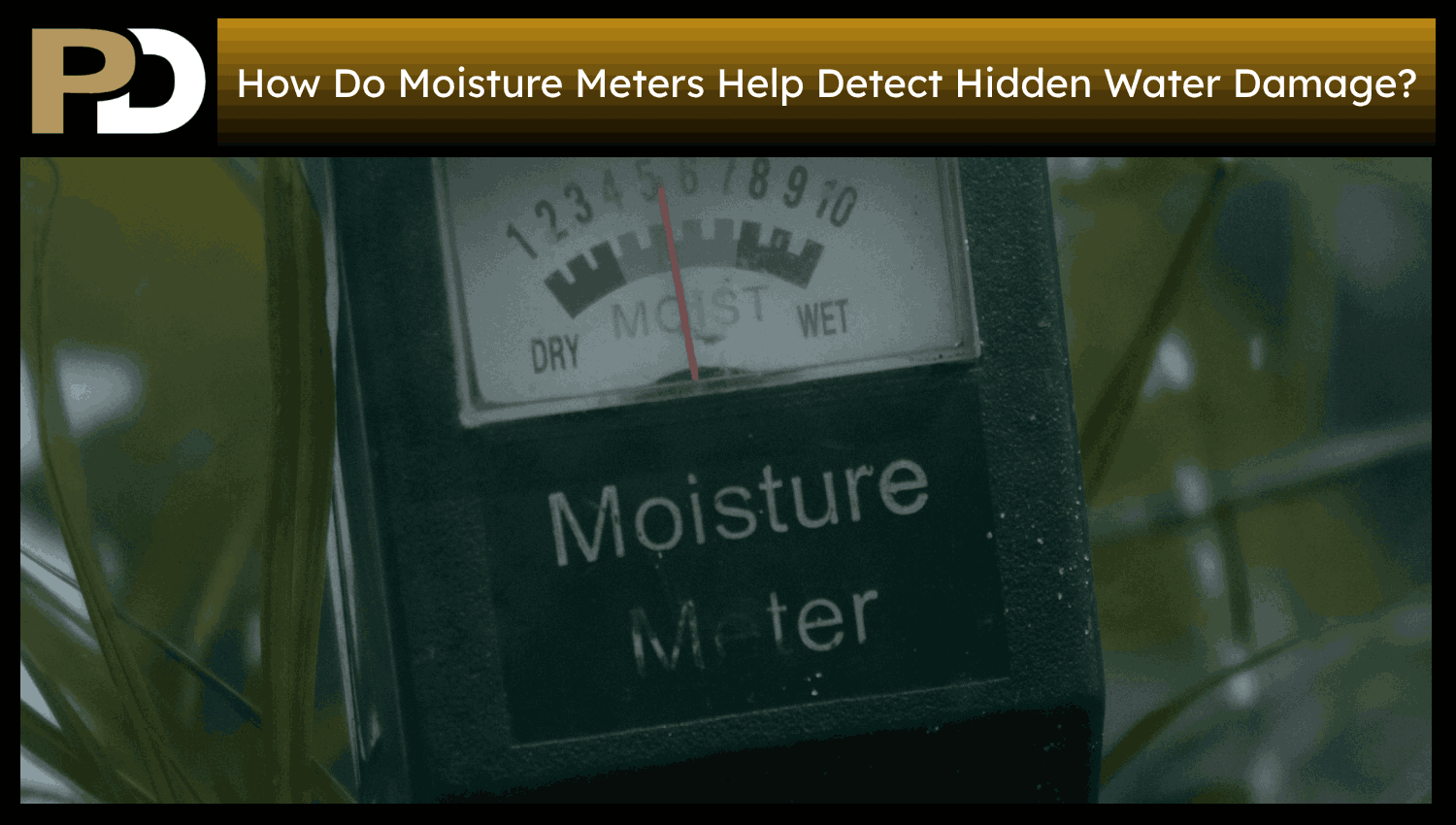
Water damage isn’t always apparent after an event. Water damage is hidden behind walls, under flooring, within ceilings, or in structural materials long before you notice stains or other visible signs of water damage. Moisture spreads undetected, so restoration specialists use certain apparatuses to detect wet materials before major damage develops. A moisture meter is one of the most prevalent instruments. Moisture meters are handheld instruments that determine moisture levels in building materials and do not rely solely on visual evidence. They assist professionals in detecting if there is water behind walls and in checking the progress of the drying out during the recovery process. Moisture meters are utilized in the aftermath of plumbing leaks, roof leaks, appliance leaks, floods, storms, and many other water damage incidents.
What Types of Moisture Meters Are Used?
Here are 2 Types of moisture meters that are used:
- Pin Moisture Meters: Pin moisture meters are moisture measuring devices with two metal probes inserted into the moisture-containing material being tested. The meter works on the principle of measuring moisture by the changes in electrical resistance between the pins. Water has a lower resistance than dry materials, so different resistance values are found depending on the moisture content. The readings obtained from pin meters are quite accurate, and they are taken at the very point of probe insertion. They are frequently utilized on wood framing, subfloors, and other structural materials where exact measurements are essential. They leave behind very small holes after testing because they penetrate the material.
- Pinless Moisture Meters: Pinless moisture meters send out an electromagnetic signal that scans below the surface without touching the material. They are great for finished walls, ceilings, flooring, and drywall since they do not damage the surface. They scan large areas and help inspectors find moisture under paint, wallpaper, or floor coverings. They are not as accurate as pin meters at an individual point but are very helpful for finding large areas of moisture before further testing.
Which Building Materials Can Moisture Meters Test?
One of the most common materials tested by moisture meters is drywall, as most often leaks from plumbing pipes and roofing leaks travel through the walls before there is any visible damage. Wood framing is also tested to see if excess moisture is being absorbed in the structure, which decreases its strength over time.
Another area of concern is subfloors that are often covered by finished flooring, where water spreads throughout the subfloor. Moisture testing is helpful before installing or restoring a floor in a room or area that has been flooded before with concrete slabs. This is because these slabs harbor moisture long after the flood or leak has taken place. Ceilings are routinely tested for roof leaks or for leaks in the plumbing above completed ceilings.
What Types of Water Damage Can Moisture Meters Help Identify?
Here are the 7 Types of Water Damage Moisture Meters Can Help to Identify:
- Hidden Plumbing Leaks: Small plumbing leaks beneath sinks, inside walls, or above ceilings often go unnoticed until there is visible damage. Moisture meters are used for detecting moisture in building materials before stains or structural damage occur.
- Roof Leak Moisture: Water penetrates through failing roofing assemblies and runs over the ceiling, down the wall cavities, and only becomes known when found in the interior. Moisture meters are useful for finding hidden wet areas and estimating the extent of moisture.
- Foundation Water Intrusion: Cracks in the foundation or porous concrete cause groundwater to enter the building, resulting in greater moisture content in basement wall sections, floor slabs, and lower sections of walls. Moisture meters detect the moisture conditions.
- Appliance Leaks: Refrigerators, dishwashers, washing machines, and water heaters leak and hide under the cabinets and floors. The moisture meters detect moisture in the surrounding area before serious damage occurs and find moisture around these appliances.
- HVAC Condensation Problems: Evaporator coils, drain pans, or condensing (drip) lines wet nearby ceilings, walls, or floors with condensation. A moisture meter is used to identify affected materials to be removed to prevent further damage from the prolonged moistness.
- Storm-Related Water Intrusion: Storms and heavy rains, high winds, or broken windows and building roofing systems cause stormwater to enter a building. Moisture meters are useful in estimating how far moisture has penetrated beyond the visibly wet areas into structural materials.
- Flood-Related Moisture: Moisture meters are used to assess the amount of water damage to drywall, wood framing, flooring systems, insulation, and other building materials after flooding. This information will be used to ascertain the amount of water exposure across the property.
What Factors Can Influence Moisture Meter Readings?
Here are the 9 Factors Can Influence Moisture Meter Readings:
- Material Density: Moisture meters are not the same on dense materials versus lightweight materials. Concrete, wood, and drywall will give different readings due to their physical properties.
- Depth of Moisture: Proximity to moisture gives different readings than moisture that is trapped further from the surface of a material. The depth of the moisture affects the result depending on the type of moisture meter.
- Surface Coatings: Certain moisture meters do not detect moisture under a finished surface with the same accuracy. Paint, wallpaper, laminate, tile, or other surface finishes affect how accurately the moisture meter detects moisture beneath the finished surface.
- Presence of Metal Components: Some moisture meter readings are affected by metal pipes, nails, electrical wiring, or steel framing embedded within the walls (especially with pinless models).
- Temperature Conditions: Extremely low or high temperatures for building materials affect moisture readings. Restoration professionals take temperature into account when using moisture meters.
- Material Thickness: Due to thick walls, concrete slabs, flooring systems, and structural assemblies, a moisture meter may not be able to measure moisture as deeply as it should. The test requires several readings to be evaluated accurately.
- Meter Calibration: The moisture meter needs to be calibrated to provide consistent, reliable readings. Improperly adjusted equipment causes moisture measurement errors.
- Comparison With Dry Areas: Most people don’t use just one reading. They evaluate areas suspected to be wet by looking at the surrounding dry areas to see if there is a higher moisture level in the wet areas.
- Moisture Distribution: Building materials are not often uniformly watered. Some places get more moisture than others and stay fairly moist. Multiple readings from several locations give a more comprehensive idea of the amount of water intrusion.