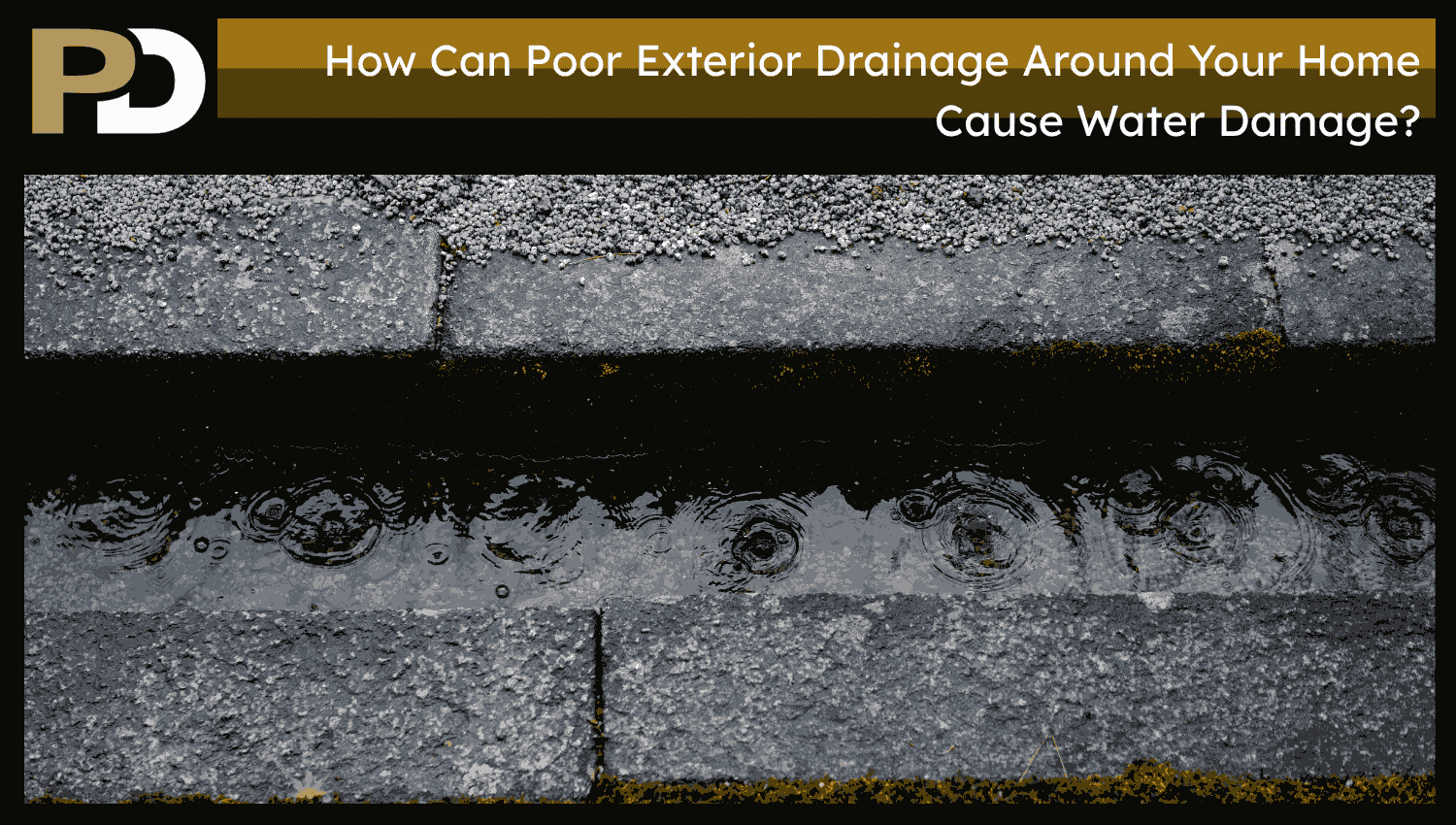
Water damage doesn’t always start within a house. Many times, it begins outside the property when rainwater is unable to escape from the property. Inadequate exterior drainage causes water to accumulate around the foundation and then seep into walls, basements, crawl spaces, and other parts of the structure. Drainage issues result from various situations, develop gradually over several months or years, and are trickier to detect than sudden plumbing leaks.
Proper grading, gutters, downspouts, and a drainage system are all meant to ensure that rainwater is safely whisked away from a building. Under these failure conditions, water takes the path of least resistance and remains near the structure after each rain event. Both residential and commercial properties are impacted over time by repeated exposure to moisture.
What Outdoor Drainage Problems Commonly Lead to Water Damage?
Here are the 6 outdoor Drainage Problems That Commonly Lead to Water Damage:
- Improper Ground Slope: The land adjacent to a building should slope away from the building to promote water drainage. Rainwater flows back towards the house’s foundation rather than off if the landscape slopes towards the house. Water accumulation causes foundation walls to be continually exposed to water.
- Overflowing Gutters: Rainwater is gathered on the roof and channeled to downspouts through gutters. The gutters, filled with leaves, dirt, and debris, overflow and dump a lot of water right next to the exterior walls. High levels of ongoing overflow cause the soil around the foundation to become saturated.
- Short Downspouts: Downspouts need to be directed away from the building. Rain gutter downspouts are too short or poorly positioned, causing rainwater to pool near the foundation. It increases exposure to moisture due to frequent saturation along the house’s perimeter.
- Standing Water in the Yard: Rainwater lingers in low spots in the yard for a long time following storms. Over time, standing water seeps into the surrounding soils, raising moisture levels in nearby foundations and exterior structures. Ponding that lasts for an extended period means the site is not well-drained.
- Blocked Drainage Channels: Other drainage structures, such as surface drains, swales and French drains, are used to remove excess water from the property. These systems become clogged due to soil, vegetation, or debris, and if they are not functioning properly, water pools around the house.
- Landscaping: Improperly designed landscapes are an unintended byproduct of a disruption of natural water flow. Raised flower beds, decorative borders, retaining features, or thick planting cause runoff to flow towards the house or inhibit drainage, leading to moisture accumulation.
Where Does Rainwater Go When Drainage Fails?
Rainwater and poor drainage cause a variety of problems on the property. It accumulates around foundation walls, where moisture gradually seeps into porous materials and construction joints. Water also gets into a basement wall below ground, where hydrostatic pressure is highest.
Soil under the building system that is saturated leads to elevated moisture levels below it. Rainwater also pools under patios, sidewalks, driveways, and other outdoor concrete surfaces, and over time, it deteriorates the soil beneath. Moisture slowly migrates to surrounding landscaping areas and to lower parts of the structure before symptoms become evident inside.
Which Exterior Conditions Indicate a Drainage Problem?
Here are the 5 Exterior Conditions That Indicate a Drainage Problem:
- Water Remaining After Rain: Poor drainage leaves puddles that don’t dry out for several days after rain. The water should drain away in a reasonable amount of time, rather than accumulate around the structure.
- Soil Washing Away: Topsoil, mulch, or landscaping materials washed away by rainwater as it runs across the property. The erosion near the foundation is likely due to poorly controlled runoff.
- Damp Foundation Walls: Damp foundation walls long after a rain event indicate that water is continually pooling against the structure as it enters the exterior of the foundation walls. Over time, they become a risk for water getting in if moisture is present.
- Uneven Lawn Areas: Poor drainage or spots that tend to collect water show up as soft, sunken, or uneven grass. The depressions tend to grow with additional moisture impacts on the soil.
- Overflow During Moderate Rainfall: The gutters, downspouts, or drainage devices overflow during normal rainfall, indicating a drainage problem around the building. Overflowing from a septic tank causes excess water to reach the adjacent foundation and landscaping.
How Does Excess Groundwater Affect a Home’s Foundation?
Groundwater creates hydrostatic pressure in saturated soils and exerts pressure against foundation walls. Below-grade structures are subjected to continuous pressure, which increases the risk of moisture infiltrating through cracks, joints, or porous concrete surfaces.
Soil also expands when watered and shrinks when dry due to repeated wet-and-dry cycles. This causes changes that take time to affect the foundation’s stability and lead to uneven movement beneath it. Settlement and foundation shifting result in various cracks in walls, floors, or exterior masonry and are caused by continued soil movement over time. Damage to foundations occurs over time; continual exposure to groundwater aggravates foundation issues.
What Parts of a Property Experience the Greatest Impact?
Basements tend to be the most susceptible, as they are below grade and are in constant contact with water-saturated soil. Water also pools beneath the flooring system, resulting in moisture in crawl spaces.
Attached garages are subjected to moisture problems due to drainage from the driveway. The exterior walls have long-lasting dampness that causes problems with masonry, siding, insulation, and structural wall assemblies. On the exterior of the building, patios, sidewalks, retaining walls, and driveways shift, settle, crack, and become uneven as supporting soil loses stability when exposed to water over time.
How Can Ongoing Drainage Problems Change Indoor Conditions?
Exterior water conditions gradually affect conditions inside the building, even if the water source is outside the building. Water intrusion through the foundation and lower walls increases indoor humidity, making the home feel damp and uncomfortable.
This moisture also creates a musty smell that becomes apparent in lower living spaces, basements, and crawl spaces. Excessive moisture from the exterior gets behind finished walls, under flooring, or through insulation, resulting in wet conditions that persist long after the rain. Excessive wetness over time causes a decrease in indoor air quality and an impact on interior building materials.
How Can Poor Drainage Influence Long-Term Property Value?
Exteriors with poor drainage devalue a home by creating uncertainty about foundation stability, frequent water infiltration, and maintenance expenses. Visible water issues, potential standing water, cracks in the foundation, or moisture problems lead buyers to believe there are more issues to address.
Drainage issues discovered during property inspections require further assessment or negotiation regarding repair costs. Constant wetness affects foundations, landscaping, hardscapes, and lower living spaces, making properties less attractive. Therefore, unsatisfactory drainage conditions lead to reduced marketability and reduced resale value of residential and commercial properties.